Wednesday, January 25, 2012

Post #4 - High Italian Renaissance Art


            In this comparative analysis, I’ll be comparing Birth of Venus by Sandro Botticelli for my representation of the Early Renaissance era.  Against this piece, I’ll also talk about the famous Mona Lisa by Leonardo da Vinci for the High Renaissance period.  Both of these paintings have similar aspects that help the transition from each time period to the next.  One reason I have chosen to use these two pieces against each other is because while they both symbolize an individual woman, they vary widely in elements that build the classical antiquity that brings these paintings to life.
            Like I mentioned, they’re both representing a woman that is viewed highly in society.  Both of the females are brighter in contrast to their foreground to help draw focus to their faces.  While in today’s standards, these women would appeal as not as beautiful, but for the timeframe, these women were considered to be some of the most gorgeous women of the time, an ideal that others that would make comparable.
            On the contrary, these are vastly wide differences between these two that have shaped the eras.  Looking at the Birth of Venus piece, we notice that Venus is not alone in the scenery, while being accompanied by other figures.  However, the location and placement of Venus in this painting is key on bringing the focal point towards the middle, where she is standing covering herself.  While she remains nude in the painting, it draws attention to the fact that she is representing beauty and sexuality.  The coloring in this piece is very cool, but also has a lot of brighter and medium shades of greens and blues, which leaves a more exaggerated feeling the viewer.  Venus seems to look more content with the events that are taking place, while her face doesn’t appear to give off any indication of darkness.  I think that this piece has dynamic unity at the same time, lacks it.  This is because we still pay close attention to Venus for reasons explained, but yet at the same time, she is not entirely alone throughout the painting.
            What makes this different from the Early Renaissance painting is the fact that like described during the reading; she is represented through dynamic unity.  Which means that she is the only thing being represented in this painting.  This is different than Early Renaissance because it focuses directly on the woman in this portrait.  Which also leads to very different focuses when composing the piece, since it relies on detail within the facial qualities.  On the other hand, with the Birth of Venus, it relies on the entire composition that pulls everything together, which leaves some slack in having to detail each face to the same extent.  Mona Lisa is also very modestly dressed, without revealing her entire body, leaving a more moderate response to this article.  While the  colors within this painting are also very neutral, and mostly darker hues.  This has been considered to be a rather dark painting that makes it unable to identify the feeling that Mona Lisa was trying to portray through her portrait.  It leaves a mysterious feeling to it’s audience that has made this a very controversial painting over the centuries.

Wednesday, January 18, 2012

Post #3 - Formal Analysis


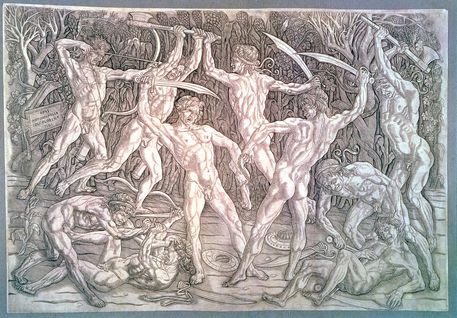
     In this formal analysis, I’d like to talk about The Battle of the Nudes, an engraving by Antonio del Pollaiuolo.  Although some may find this piece rather odd and unsettling, I can’t help but be simply fascinated by the amount of detail and realism that has been incorporated into this engraving.  My initial thoughts of when I study this piece of art is overwhelming, it leaves so much to the imagination, almost as if the artist wanted his audience to build their own conclusions on it.  I feel like this could be attributed to the lack of color within it.

        Something that has really drawn my attention to this piece is the level of sophistication and extreme detail that del Pollaiuolo expresses.  There are a wide use of lines, which vary in size, depth, and width.  Each has its own purpose to highlight certain parts of the male figure or the foliage displayed in the background.  It can be clearly displayed how each figure of the fighting males is moving in a certain way to extend and contract each muscle group.  In the book, it talks about how this piece of a perfect example of classical sculpture and anatomical research, and I couldn’t agree more.  During the fifteenth century, artists were still developing and experimenting with new ways to paint, engrave, and even sculpture, but this level of anatomical experimentation takes it to an entirely new level.  One solid piece to support this would be to look at the figures in the piece that have a weapon drawn or are in the act of swinging their weapon of choice.  Now take a look at the figure in the bottom right that appears to be injured from the battle.  We can clearly see that the muscles are not as defined as the figures that are still caught in the heat of the battle.  I find this as a fascinating part of the artist’s background, since there are people today that are still having a hard time grasping the concept of human anatomy within artwork, and this was created centuries ago.  In my opinion, del Pollaiuolo was ahead of his time with highlighting pieces of human anatomy.

 
     Though this piece looks quite amazing in a picture within a book, I can only imagine what it would look like in a person.  With this being said, another thing that really stands out is the absence of color.  While this may appear to be a more tasteless piece to some, it really draws my attention and leaves me in a moment of thought.  Like I mentioned before, it really leaves a lot of emphasis on the viewer, who is left to draw their own conclusions based on the colorless battle scene.  It helps highlight the muscle definition as we can see the lighter engraves help bring out the abdominal and oblique muscles. 

            Since this piece has no sort of added color to it, it expresses different levels of aspect through the shading of the engraving.  As we can see, the foliage in the background appears to be a lot darker than the male figures fighting.  We can also depict that the figures that are standing are carved much lighter than the figures that are closer to the ground.  Since there is no use of other colors, I feel Antonio del Pollaiuolo has used other resources to highlight where our focal point should be drawn to, which has added a deeper level of aspect and depth.

 
     Another key component that has been added is the false illusion of movement.  If we were to take a few seconds to study over this engraving, it would appear as if the naked male figures in this piece are actually in motion has they are lunging their weapons at each other.  It is also noticed that all the figures in this piece appear to be the same person, or have equally as noticeable qualities.  Whether this is a symbolic meaning or if the artist simply made all the male figures appear the same, it is still highly impressive to illustrate each character so closely through different muscle tensions.  Overall, I found this as a fascinating piece and a rather refreshing change from all the commonly publicized paintings that most people think of when it comes to Renaissance Italy in the fifteenth century.

Wednesday, January 11, 2012

Post #2 - Northern Renaissance Documentary


            During the rebirth of Northern Renaissance, artists took a different approach to their masterpieces.  Paintings and sculptures were the most popular forms during this era, and it countered what was presented in earlier times prior to this.  Although these pieces were attributed and influenced by the church, they contained more than just figures, they presented a story that could be aesthetically portrayed.  Famous artists such as the Jan Van Eyck from the documentary, not only created marvelous pieces that would flourish, but he invented a new way to approach the techniques of painting.  One of the most remarkable things that Van Eyck did in the film was creating images that not only reflected the light in the suggested areas, but he complimented it with the lighting that would directly affect the painting in reality.  This was something that nobody had ever been exposed to before.
            As the paintings and sculptures were widely popular, they had reason to stand out as much as they did back then to even today.  Within the documentary, they explained how each sculpture was almost embellished with its own personality, its own detail that separated each sculpture so much more from its accompanying pieces.  This gave character to each sculpture as it emphasized space and realism through each particular little detail.
            It appears that the influence of these works have changed drastically from prior forms, as they now focused on things that were now demanded by churches and patrons, which transformed the aspect of painting from a hobby to a highly respected career.  While religious forms of art were still desired, they found new ways to depict how they could make these images or stories come to life.  Another high value that was influenced in this time was patrons having artists painting portraits of themselves or regarding their family, which became overly popular in the 15th century.
            However, when paintings became the newest standard of artwork, Van Eyck’s career really took off.  It was the first time that painters were now heavily commissioned for their work from their patrons, and it opened new doors for artistic creativity.  As mentioned, there were many influences that directed how paintings were to be crafted.  Religious pieces such as the early alter-pieces have always played a large role in Renaissance art, but it gave artists the opportunity to express more than just one image, instead a collection of images that elaborated a story.  They also focused on creating images that were of everyday events that played an important role in Renaissance culture and sometimes even reflected art of an accomplished victory during a battle.  But soon after this stage, many painters transformed their skills into portrait paintings, usually suggested by the patron of the artist at the time.
            One thing that I believe really separated North Renaissance from the rest was the extreme attention to detail that the artists put into their masterpieces.  It was here that figures like Van Eyck really etched a name in what could be considered even in today’s standards as artwork that has more detail than a photograph.

Friday, January 6, 2012

Art 236 - Introduction Post

A little introductory about myself: my name is Kyle Gromala and I am continuing on with my Art History classes just as most of you are.  I'm currently seeking a degree in Fine Arts / Photography.  I'm currently a junior here at Central and am trying to decide if I will pursue grad school when the time comes or join the working world.

When I think of Renaissance Art, so many things come to mind.  As we know, it was a great breakthrough with artwork and experimentation, but it was also a turning point when people started thinking in a new and unusual way.  Artists went against what others thought as farfetched and continued to do it anyway, revolutionizing certain techniques that have been popularized even in today's society.  Although I am not very familiar with too much Renaissance art specifically, (which I know will change over the next few weeks) I do know that it was an era of creativity and exploration.  Such examples were the large named artists that everyone and their grandmothers know about such as Michelangelo, da Vinci, and Giotto.  These artists didn't become legends for no reason, they changed the face of the artistic world.  New aspects were constantly being introduced into this time frame, such as the integration of three-point perspectives, which continued to protrude through famous paintings and canvases amongst many emerging artists.  I am looking forward to this class quite a bit more than Medieval and Ancient History because of all the new aspects and ideas that were expressed during this era.  It was truly a time of brilliance and expressive creativity.

Wednesday, November 30, 2011

Post #9


During this quarter, I have taken a higher interest and appreciation for the ancient architecture that can be viewed as art.  Most importantly, such works as Stonehenge, the Parthenon, and the Temple of Aphaia.  I find these pieces of work to stand out above others through the ages because of the severe complexity that has been put into raising these marvelous structures.


The Parthenon, although a popular piece that we associate with ancient Greece art and culture, stands out to me as one of the most well thought out pieces of architecture from the centuries.  Not only does it serve its aesthetic purpose, it has been composed and designed by the idea of math; there is much more to the structure than just a few pillars and columns strategically placed, it has been mathematically calculated to each exact point.  It highlights areas of precision and pays close attention to proportions throughout the entire building.


Another piece which has been considered artwork and highly controversial over the centuries is Stonehenge.  One of the greatest attracting ideas to this architecture is the fact that nobody is quite sure of how it became to be, where it came from, or what it even symbolizes; its entire existence is just a giant question.  To think that some of the stones average around from 13 to 24 feet tall and weighed up to 26 tons each makes it hard to believe that people could construct this during the 2500 B.C. era without the help of machines or devices.  There are even such theories that such figures as Merlin, who was the magician of the King Arthur legend had built it and that Stonehenge was the primary location for Celtic druid rituals.  Something that leaves me thinking about the idea of the architecture of this is the fact that the bluestone was not located anywhere close to where the actual stones are placed.  The book refers that they would have been moved over 150 miles from the west in order to arrive to their current location, which makes us wonder how that is humanly possible without the technology we have today.


Along with these two pieces, I found the Temple of Aphaia to be rather intriguing as well.  The way that the temple was structured and designed showed that there was also a fair amount of time put into figuring out how the columns would hold the roof and combining structures.  The temple also uses mathematical proportions within their columns that expressed artistic creativity by the engravings towards the top.

I realize that some of these may be a little cliché in the terms of what artwork we should be choosing to focus on since we covered so much, but the architecture just stands out so much above the rest to me that it is hard to ignore.  Such intricate and mathematical measures have been presented in creating these columns in most of these temples that it is fascinating to think somebody could replicate these detailed designs over.

Wednesday, November 9, 2011

Bust of Commodus as Hercules vs. Caracalla

  In these sculptures, both contain various attributes that can be considered as power.  Both figures were sculpted to highlight their facial structure definition, to show that they were probably wealthy and powerful judged off their looks.  On the other hand, there are very contrasting points within these pieces.  For example, Caracalla has a V-shaped forehead above the eyebrows, which gives off more of a sinister, dark feel to his personality.  Perhaps he ruled the people by being notorious and ruthless, thus winning the hearts of his followers by fear.  In the Bust of Commodus as Hercules, the statue seems more relaxed and apathetic.  The figure in the sculpture seems like he presents more of a calm, monotone presence over people, making him a selected person that people would more look up to rather than fear.  At the same time, he has a fanged animal trophy over his head and draped around his neck, showing that he is fierce and a fighter.  Not to mention, the club he holds in his hand as well shows that he is a combatant.  Caracalla is a more simple piece and only draws my attention because of how much anger is carved into this sculpture.  It is almost scary how his face is positioned and even more creepy how his eyes are looking straight up.  It appears as if he is looking up towards the Gods in spite of something.  Caracalla would appeal more to the fighting type people as he highlights as a ruthless leader of anger and blood, which Commodus as Hercules appears more as a loving warrior that would rather capture the trust of individuals.

Wednesday, November 2, 2011

Greek Art - Option #2

     I personally think that the Parthenon Marbles should be relocated back to Athens.  I'm aware that this is a highly debated subject and a part of me knows that there is no right or wrong answer to solve this case.  If we were to look back into other events such as artifacts that were looted during Iraq's liberation, it was a bad decision to hold their arts/history in a museum in such a dangerous location.  However, it still belongs to their country and ancestors/people that belong to its history, whether or not it is in a safe place.  I do think that during the time, Britain was entitled to owning these marbles since Greece wasn't entitled to their freedom yet during the ruling of the Ottoman Empire.
   
     Also, I feel like the Parthenon Marbles was a very important part of Greek culture and has a highly popular image as the aesthetic architecture movement.  Being located in the British Museum entitles that it would also be safer due to the pollution eating away the marble issue that was also addressed in Athens.  At least in Britain, it will be properly preserved and displayed for centuries to come.  So the great question is, would it make more sense to keep it here in order to ensure its survival?  Probably.  But would it be disappointing if someone was set on seeing Greek art over in Greece?  Yes.  If Britain is to continue displaying this art, I think it should be presented in a more historical context since this type of work was made popular by the Greeks.  It is a piece of their history and establishes their roots.  Like I mentioned before, there is no right or wrong answer, and I've somehow caught myself in the middle of both sides.  But if I had to choose a particular case to follow, I'd have to say that Greece is entitled to own their own heritage.